


Front-Operated Drawer for Routine Fiber Work
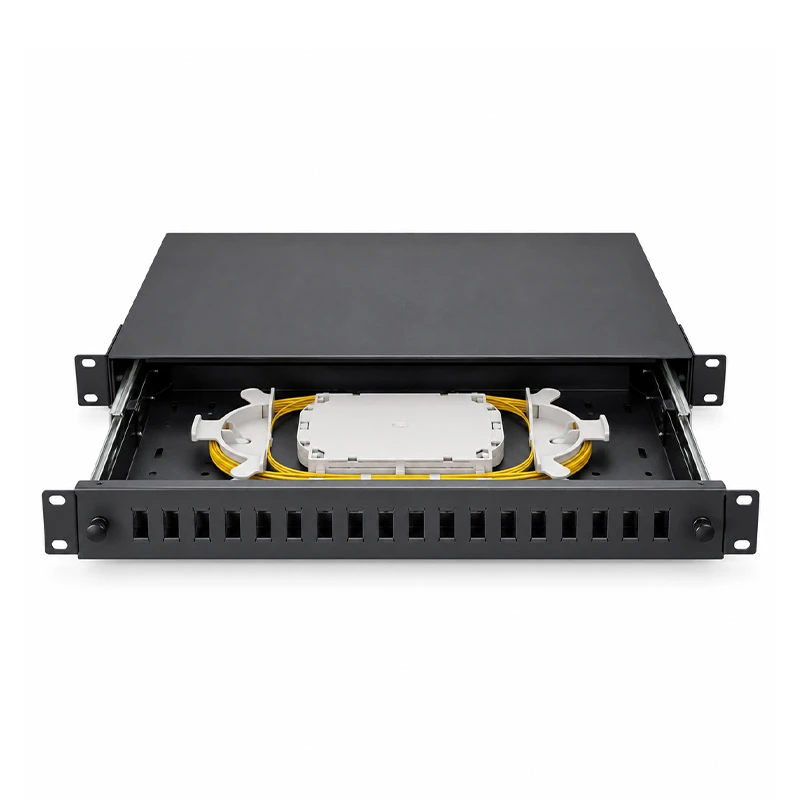
The Sliding Drawer Fiber Terminal Box is designed around convenient access to internal fiber connections after the unit has been installed in a rack. Its drawer section can be pulled forward for fiber splicing, inspection, and patching operations without removing the entire rack unit.
The enclosure uses sheet metal with a sprayed finish and is available in 12, 24, 48, and 72-fiber configurations. It fits a standard 19-inch rack and is typically supplied in 1U, 2U, or 3U heights. The sliding structure supports front-side fiber management and provides a practical operating format for communication cabinets where maintenance access is an important selection factor.
Separate Areas for Splicing and Fiber Storage
Independent internal areas for fusion splicing and spare-fiber storage help keep optical routes more clearly organized. This arrangement is useful when technicians need to check splice conditions, change fiber connections, or perform regular maintenance.
The pull-out structure makes the internal fiber area accessible while the main unit remains mounted in the cabinet. The product is suitable for server rooms, data centers, communication rooms, and network systems where fiber connections may require frequent adjustment or inspection.
Maintenance Access as a Structural Priority
For projects where fiber connections are expected to change over time, the drawer design provides a different operating method from a fixed enclosure. Technicians can pull the working section forward, inspect the fusion and storage areas, complete the required fiber work, and return the drawer to its installed position.
The 1U, 2U, and 3U options allow buyers to choose a suitable chassis height while retaining the same front-access concept. Fiber count, rack space, and expected maintenance frequency can therefore be considered together when selecting the configuration.
Configuration and Sample Preparation
OEM/ODM production is available, and manufacturing can also follow customer technical drawings or prototypes. Buyers can confirm fiber capacity, U height, cabinet conditions, and structural requirements before formal manufacturing begins.
Samples can be supplied before batch production. Customized sample development normally takes about one week. During production, videos can be provided periodically so purchasing teams can follow order status. Standard products generally require about 15 days for production, while customized versions usually require 1-2 months.
Production Verification and Follow-Up
Raw materials are inspected before entering production. Manufacturing includes patrol inspection, self-inspection, and cross-inspection. Finished products are tested before release, followed by a 100% inspection before packing. Third-party inspection can also be accepted.
Production-stage management covers product quality, delivery timing, and progress communication. After-sales follow-up and requirement response are also available for later equipment-room expansion, equipment adjustment, and repeat purchasing.
Product Specifications
|
Specification |
Details |
|
Enclosure Material |
Sheet metal with sprayed finish |
|
Fiber Capacity |
12, 24, 48, 72 fibers |
|
Rack Compatibility |
Standard 19-inch rack |
|
Typical Height |
1U, 2U, 3U |
|
Structural Feature |
Sliding drawer structure with front-side fiber management |
Hot Tags: sliding drawer fiber terminal box, China sliding drawer fiber terminal box manufacturers, suppliers, factory, Fiber Optic Cable Distribution Box, Fiber Optic Cable Splice Closure, Fiber Optic Distribution Module Unit, Fiber Optic Distribution Panel, Fiber Splice Distribution Unit Box, MPO MTP Fiber Optic Patch Panel


